The Veil over Unity
Let's start with something we think we understand: light. That's where we left off in our last article about Light, Space and Time.
You know from high school that light behaves like a wave. When you shine light through two narrow slits, you don't get two bright lines on the screen behind them. Instead, you get an interference pattern. Bright and dark bands, spreading out from where you'd expect just two spots. This happens because light from the two slits interferes with itself, just like water waves do when they pass through two openings in a barrier.
The bright bands appear where the waves from both slits arrive in phase, reinforcing each other. The dark bands appear where they arrive out of phase, canceling each other out. Wave behavior, pure and simple.
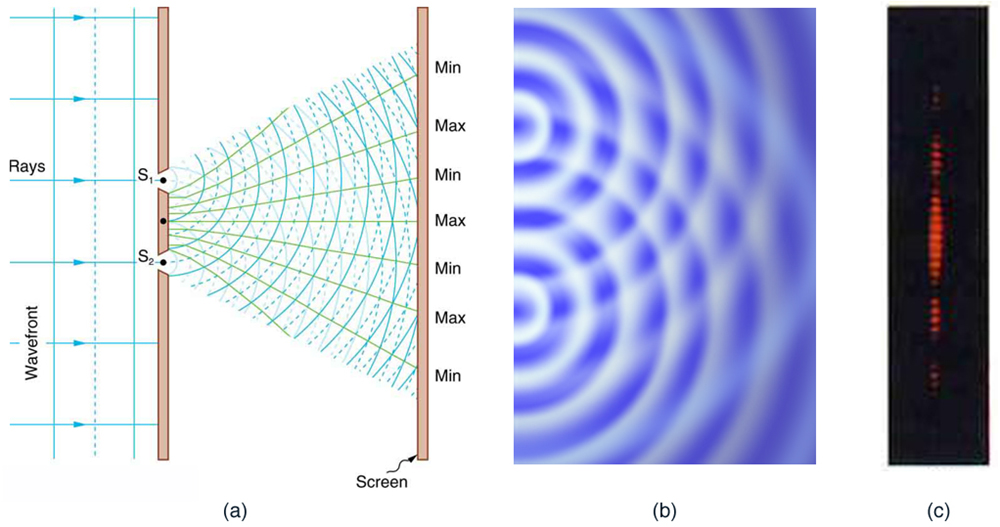
Now do the same experiment with electrons, firing them one by one at the two slits. What do you think would happen?
You might think electrons are particles, little balls with charge, so they should go through one slit or the other, and you should get two clumps on the screen, one behind each slit. But that's not what happens.
Fire thousands of electrons, one at a time, waiting between each one so there's never more than a single electron in the apparatus at once, and slowly, gradually, an interference pattern emerges. The same bright and dark bands you get with light. Each individual electron hits at one definite spot, like a particle. But collectively, the pattern they form is exactly like a wave passing through both slits and interfering with itself.
This is weird for our intuition of electrons as little balls with charge. Each electron is alone in the apparatus. It can't be interfering with other electrons. So what's interfering with what? Unless of course electrons are also waves, just like light.
You can even do this same one-particle-at-a-time thing with light, when you make the light dim enough. Just like electrons, you see each photon arrive one by one, each hitting at a single spot. But build up enough detections, and the interference pattern appears. You can watch Looking Glass Universe's video on this topic, and read about the single-photon experiment in this paper.
So light and electrons behave exactly the same way. Each arrives as a localized "chunk" at one spot. But the pattern they collectively form is a wave pattern, requiring interference from both slits.
This is what physicists mean by wave-particle duality. We say quantum objects "travel as waves but exchange energy as particles." The wave describes where they can go, giving probabilities for different locations. But when they arrive, when they interact with a detector or screen, they do so at one definite spot, transferring a quantized chunk of energy.
Wave-particle duality is real. Quantum objects, whether photons or electrons, exhibit both wave-like propagation (creating interference patterns) and particle-like detection (arriving at definite locations). They "travel as a wave" through space, but "exchange energy as a packet" when measured. Whatever that means.
When Separation Breaks Down
So we have wave-particle duality. Strange, but maybe we can live with it. Electrons and photons are tiny, so maybe the rules are just different down there. Maybe they're some kind of fuzzy wave-particle hybrid in reality that is hard to measure without "disturbing it". But we can still think of these wave-particles as individual, separate things.
But that separation breaks down completely when we look at entanglement.
Let's start with two electrons that have been created from the same event, and thus share equal and opposite spins but we don't know which direction it is. Send one to Earth, the other to Mars. They're now separated by hundreds of millions of kilometers. Now measure the spin of the Earth electron. You get a result: up or down.
Immediately, without any delay, the Mars electron's spin becomes correlated with your measurement. If you measure the Mars electron's spin along the same axis, you'll find the Earth electron had the opposite value. Every single time.
You might say: "So what? They decided their spins when they were created. The Earth electron was always going to be spin-up, and the Mars electron was always going to be spin-down. We just didn't know it yet."
That was Einstein's hope. He thought there must be "hidden variables", properties the electrons carry with them that determine what result you'll get when you measure. Like a pair of gloves in separate boxes. Open one box, find a left glove, and you instantly know the other box contains a right glove. No mystery or faster-than-light communication.
But in 1964, John Bell proved that's impossible. He showed that if hidden variables existed, measurements at different angles would have to obey certain statistical limits, what we now call Bell inequalities. Then he showed that quantum mechanics predicts violations of these limits. The correlations are too strong to be explained by any pre-existing local properties.
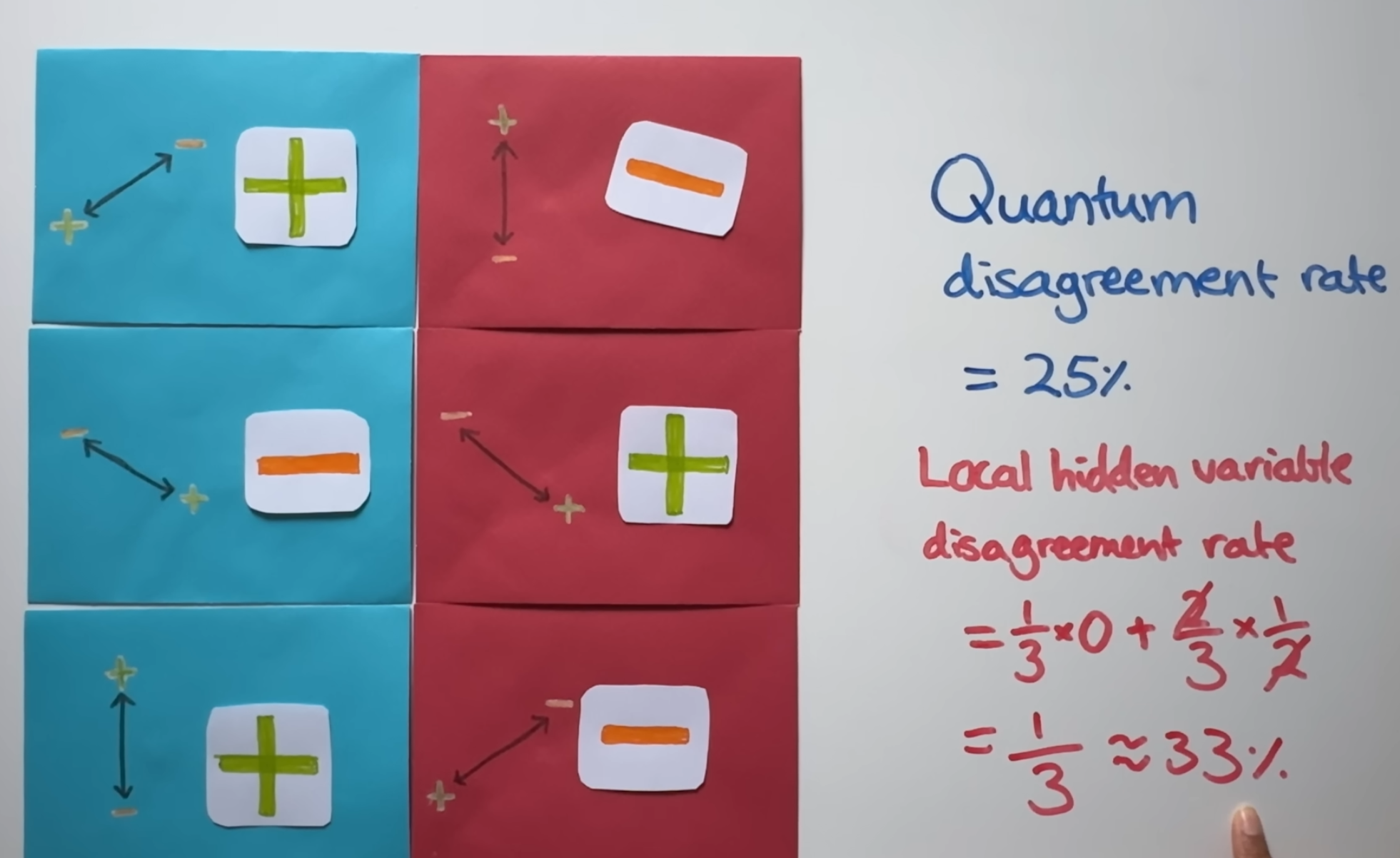
His theory has been validated with experiments. Over and over, with increasing precision. The results are clear: Bell inequalities are violated. The electrons don't have definite spins until you measure them. And when you measure one, the other "knows" instantly, regardless of the distance between them. Watch Veritasium and Mithuna's video on entanglement to understand this better.
Einstein's main problem with this was breaking the universe's speed limit of communication, because the particles are communicating with each other instantaneously, faster than light. But this doesn't "allow" communication outside of the two-particle systems internal states. You can't hack these two particles two send information this way, because the person on Mars sees random results until they compare their notes with the Earth person. The correlations are real and instantaneous, but they're internal to the particle-pair system.
But this challenges our intuition of seeing particles as separate entities. This non-locality of two particles means they're the same system, not two different independent entities. There's another way to see that reality is non-local, called the Aharonov-Bohm effect, and I find it even more mysterious.
Take an infinitely long coil of wire and run a current through it. A magnetic field will be generated inside it, with none present outside. Sealed off from the outside world.
Now split an electron beam and send it around this wire, through the region where there's no field. What happens? If fields are what affect particles, and the field is zero where the electron travels, nothing different should happen. The electron interference pattern should look exactly the same with or without the coil.
But that's not what you observe. The electrons' paths are affected, changing the interference pattern at the destination. As if the two paths accumulated different phase shifts. There is no magnetic field present outside the coil, and yet the presence of a field inside that can give us a measurable difference in the interference pattern.
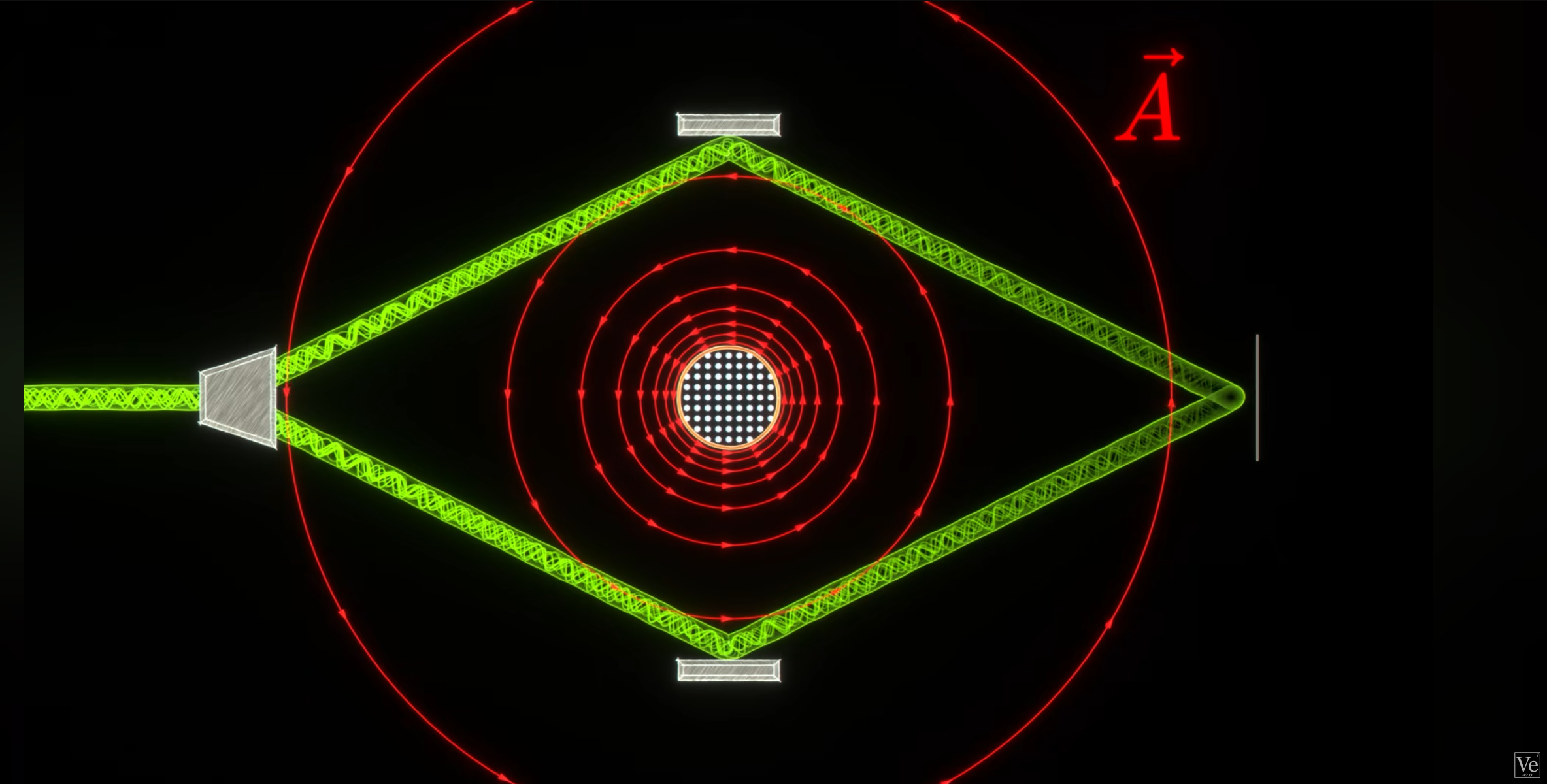
Something called the magnetic potential that exists in the space around the coiled column is the difference. You could say the potential is "more real" than the field. You can see a beautiful explanation of this in Veritasium's recent video on the Aharonov-Bohm effect, which goes into detail about the advanced experiments done to rule out leaking magnetific fields by generating magnetic fields inside a torus.
Both the magnetic potentials and the electron phases are not directly measurable. But they do exist, are correlated with each other, and in some sensor they are more real than the field values or a single electron hitting somewhere. We might like to think of electron waves as abstractions and magnetic potentials being just a mathematical convenience. But we would be wrong to do so.
Both of these experiments, Bell's and Aharonov-Bohm's, are telling us the same thing. The picture of reality as made of separate, localized regions or entities, is wrong. At the fundamental level the quantum realm is much more connected and inseparable than what are intuitions would like us to believe.
When two electrons are entangled, they're not two separate particles that happen to have correlated properties. They're a single quantum state, a unified whole. And similarly, the phases of an electron wave or the potential around a magnetic field isn't just a mathematical convenience we use to calculate the "real" physics of individual electron particles and magnetic fields.
Reality at the quantum level is non-local, hence non-dual. The universe, at its deepest level, is much more inseparable than we like to think. We can't draw clear boundaries between inside and outside, or between particle A and particle B. There is a unitary quantum wave-function underlying all separate measurements.
How the One Becomes Many
So if reality is fundamentally non-dual and non-local, why does the world appear so definitively dual and local? Why do I see separate objects in definite places? How does the unified quantum field give rise to the classical world of distinct, separate things?
Part of the answer lies in a process called decoherence.
Let me show you with a puzzle that bothered physicists in the early days of quantum mechanics. It's called Mott's problem, and it beautifully illustrates how apparent duality can emerge from non-duality.
When a radioactive atom decays, it spits out an alpha particle (a helium nucleus). According to quantum mechanics, this alpha particle emerges as a spherical wave, spreading out equally in all directions from the nucleus. It has no definite direction of travel. It's equally likely to go left, right, up, down, or anywhere in between.
Now place this radioactive source inside a cloud chamber, a device filled with supersaturated vapor. When a charged particle passes through, it ionizes atoms along its path, and tiny droplets condense around these ions, making the particle's track visible.
If you try this out you will see a single, perfectly straight track in the cloud chamber. The puzzle is why? Shouldn't a spherical wave randomly ionize atoms throughout the entire chamber, creating a fuzzy cloud rather than a line?
This bothered Einstein and other physicists deeply. In 1929, Nevill Mott solved it, and his solution is considered one of the first examples of decoherence theory.
The key insight was that you can't think about the alpha particle alone. You have to consider the alpha particle plus all the atoms in the cloud chamber as one unified quantum system.
When Mott did the calculation, he found something remarkable. Yes, the alpha particle starts as a spherical wave. But as soon as it ionizes the first atom, the quantum state of the entire system (particle plus that atom) becomes entangled. This entanglement makes it overwhelmingly more probable that the next ionization will happen nearby, along a straight line from the first one.
Each successive ionization reinforces this pattern. Not because the alpha particle is "really" traveling in a straight line, but because the entanglement between the particle and the environment (the cloud chamber atoms) causes the different possible directions to decohere. They stop interfering with each other.
The spherical wave doesn't collapse into one direction. It evolves into a superposition of many different straight-line possibilities, but these possibilities no longer interfere.
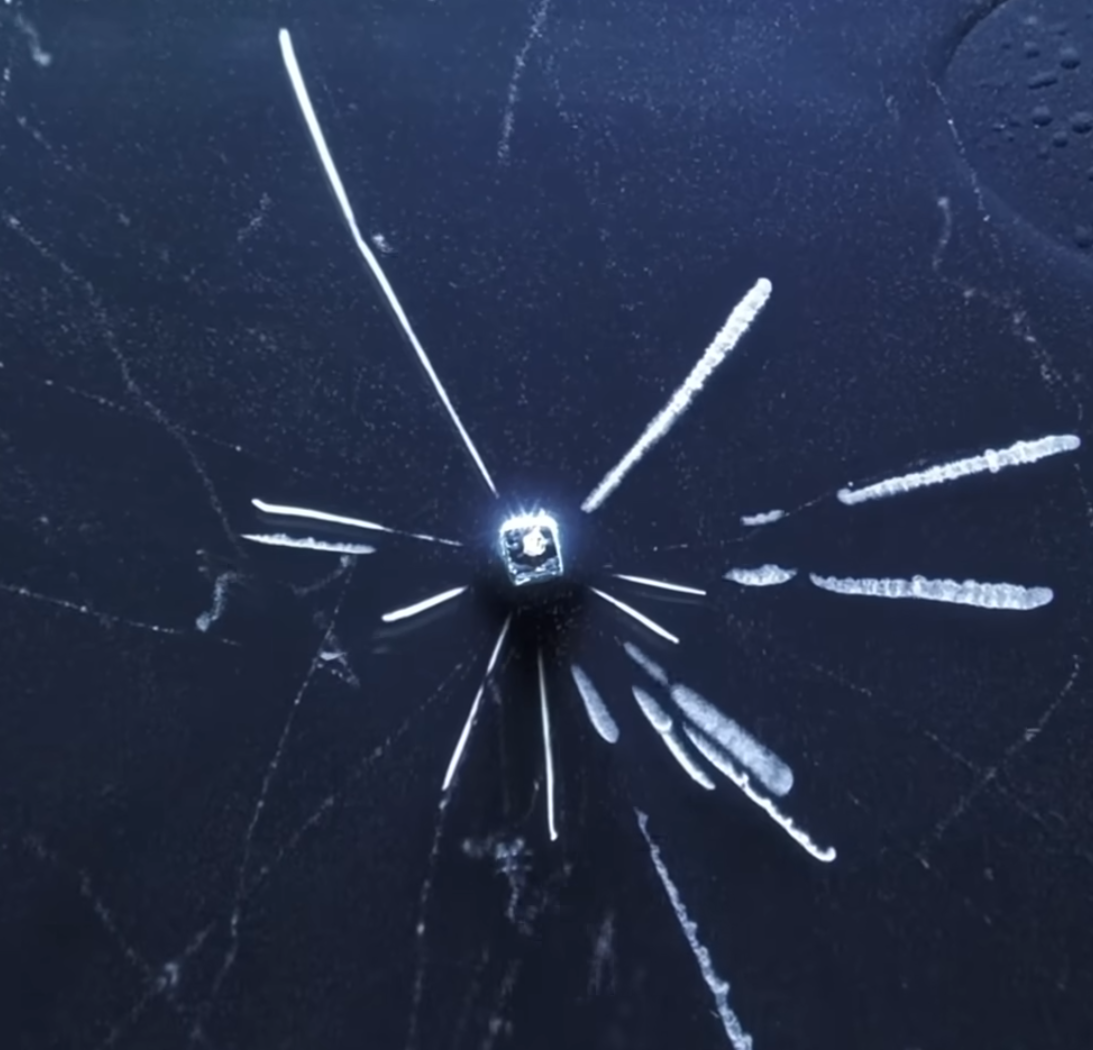
You can explore this in detail in this excellent video by Action Lab on Mott's problem and decoherence.
This is how the classical world emerges from quantum mechanics. Large objects are constantly bombarded by photons, air molecules, and countless other particles. Each interaction entangles the object with its environment. This entanglement washes out the quantum interference effects that would reveal the object's wave nature. What remains is more discrete and "classical"-like.
Decoherence explains why a continuous wave-function of probabilities can clump into discrete paths. It's a bridge between the non-dual quantum world and the dual classical world we experience. But only half a bridge. Because it can't really explain why we only ever see one outcome.
In the cloud chamber, decoherence explains why we see a straight track rather than a fuzzy cloud. But it doesn't tell us why the track goes in this direction rather than that one. The spherical wave contained all possible directions. Decoherence separates these possibilities into non-interfering branches. But those are still multiple branches, while we only ever see one.
That's where the Born rule comes in. The Born rule says the probability of observing a particular outcome is given by the square of the wave function's amplitude. Where the wave is strong, you're more likely to see that outcome. Where it's weak, you're less likely.
But the Born rule only gives probabilities. It doesn't tell us which specific outcome will occur. That appears to be fundamentally random. Not random because we lack information about the particular thing (Bell's theorem ruled out local hidden variables, remember). But random in a deeper sense.
The universe doesn't "decide" which direction will the alpha particle go beforehand and store it somewhere inside the atom. But we still only see one, and if we do an experiment multiple times, the probability is equally distributed in this case. The second-half of our bridge between duality and non-duality is missing.
The Born rule is the deepest mystery. We can describe with perfect precision how the non-dual quantum field evolves using the Schrodinger equation. We can calculate exactly how it decoheres into separate, non-interfering branches when it interacts with an environment. We can predict the probabilities for different outcomes with stunning accuracy. But why and how does one of them get picked? We have no idea.
The Veil of Maya
If you've studied Advaitic philosophies like Vedanta or Trika, what I've just described might sound strangely familiar. The ultimate reality is seen as Brahman or Shiva. The Vast. The Infinite. A-dvaita literally translates to Not-two. So this vast universe is not really separable, as we see when we go down to the smallest "particles".
What we perceive as the world of separate objects, distinct identities, individual locations, all of this is Maya. Not illusion exactly, but a kind of appearance, a superimposition on the non-dual ground of being.
In Advaita, the question "why does one appear as many?" is considered ultimately unanswerable. It's the nature of Maya to veil the non-dual reality and project the appearance of multiplicity. How this happens, why it happens, cannot be fully explained. It's the inexplicable power of the underlying Sat-Chit-Ananda or Brahman, to appear as the world of multiplicities. The key word being "appear".
In quantum mechanics, the question "why does measurement select one particular outcome from the superposition?" is unanswerable too. It's the nature of quantum measurement, described by the Born rule, to produce definite results from indefinite possibilities. The randomness is fundamental, not a placeholder for local, hidden ignorance. Why the probabilities "collapse" the way they do remains a mystery.
In Trika, the underlying reality of Shiva, or pure awareness, is the same as Shakti, or energy. All experiences we have are energetic vibrations or Spandan of the pure awareness. Just like the particles we perceive as separate are wave-like vibrations of the underlying field. They see Shiva and Shakti as two sides of the same coin.
🪷 All is Unfolding 🪷
The multiplicity, the separation, the definite positions of distinct objects, all arise within the underlying non-dual ground of reality. How they arise, why one possibility manifests rather than another, why this thought appears now, why that electron hit this spot instead of that one, these questions may have answers but they are veiled from us.
But we can face the veil. Not by explaining it away, but by recognizing how different traditions with completely different values and processes point to the same underlying non-duality. We can embrace it by not binding our self-identification to the mere particles that make up our body and mind, and instead seeing our individual self as the whole. Because ultimately, You are That.
Here's a verse from Japji Sahib to close this up:
हुकमी हुकम चलाइ राहु ।
नानक विगसै वेपरवाहु ।।
Hukami Hukam Chalaye Rahu,
Nanak Vigasai Veparvahu
The willer keeps willing,
O Nanak, blossoming without care.